

Luxury SUV Market to Reach USD 453.10 Billion by 2035 at 5.98% CAGR
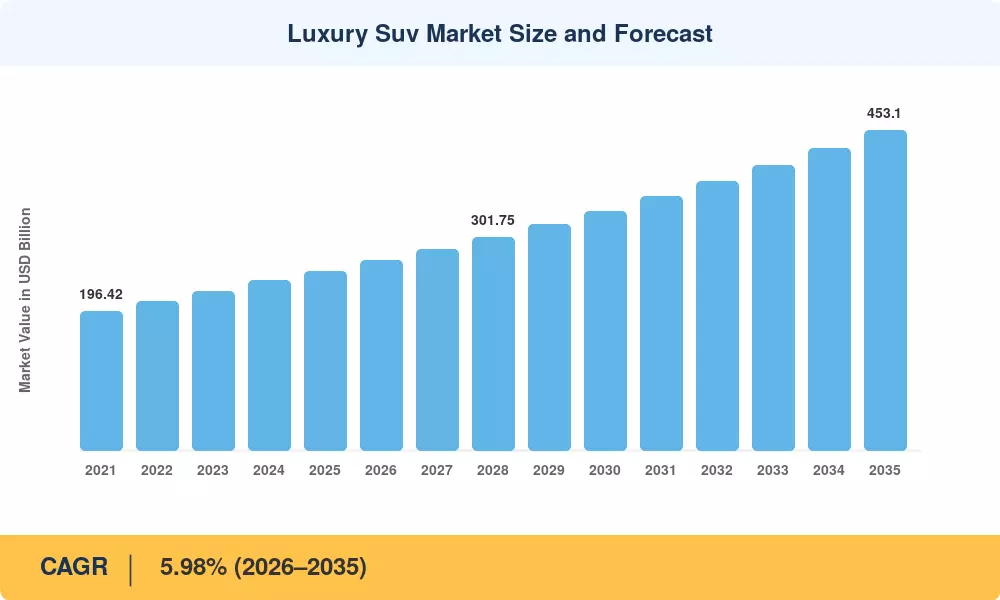
Luxury Suv Market
The global Luxury SUV Market stood at USD 253.50 Billion in 2025 and is projected to reach USD 268.66 Billion in 2026.
The global Luxury SUV Market stood at USD 253.50 Billion in 2025 and is projected to reach USD 268.66 Billion in 2026 before climbing to USD 453.10 Billion by 2035.”
NEW YORK, NY, UNITED STATES, July 23, 2026 /EINPresswire.com/ -- The global Luxury SUV Market stood at USD 253.50 Billion in 2025 and is projected to reach USD 268.66 Billion in 2026 before climbing to USD 453.10 Billion by 2035, registering a CAGR of 5.98% across the forecast window.— Arti Dhapte
Market Overview
Luxury SUVs represent the pinnacle of the sport-utility vehicle segment, combining premium craftsmanship, advanced technology, powerful performance, and distinctive design with the elevated ride height, commanding road presence, and versatile interior space characteristic of SUVs. These vehicles typically feature high-performance powertrains—including V6, V8, and increasingly electric and hybrid options—alongside sophisticated all-wheel-drive systems, premium interior materials, and the latest in connectivity and driver-assistance technologies. The luxury SUV segment encompasses a diverse range of body styles including standard SUVs, crossover SUVs, and coupe-style SUVs, catering to affluent consumers who prioritize a combination of prestige, utility, comfort, and performance in their vehicle choice.
Two forces are propelling this trajectory: a sustained rise in global high-net-worth individual (HNWI) populations—Knight Frank's 2024 Wealth Report counted 2.7 million ultra-HNWIs worldwide, up 4.2% year-on-year—and an unmistakable buyer migration away from premium sedans toward sport-utility body styles that offer both road presence and interior versatility.
A powertrain transformation is rewriting the competitive playbook across the Luxury SUV Market. Legacy naturally aspirated and turbocharged petrol architectures are giving way to battery-electric platforms, with OEMs committing over USD 515 Billion collectively to electrification through 2030. The EU's Fit for 55 package, which mandates a 55% CO₂ reduction by 2030 relative to 2021 levels, is accelerating this shift in Europe, while China's dual-credit NEV policy pushes domestic and foreign brands to scale zero-emission SUV line-ups rapidly.
Industry trends indicate a decisive shift toward dedicated EV-native platforms, software-defined revenue models, and autonomous driving integration. Automakers building ground-up battery-electric platforms—rather than retrofitting ICE architectures—can achieve 15–20% improvements in range efficiency and interior volume. Over-the-air software updates and subscription-based feature unlocks are creating recurring revenue streams, with per-vehicle digital revenue estimated to reach USD 800–1,200 annually by 2030. Luxury SUVs serve as the primary commercialization platform for Level 2+ and emerging Level 3 autonomous capabilities.
Technological developments are rapidly expanding the market's capabilities and appeal. Electric drivetrains unlock instant torque, whisper-quiet cabins, and flat-floor packaging that premium buyers value, while solid-state battery commercialization, expected between 2027 and 2029, could extend luxury EV range beyond 700 km and cut charging times below 15 minutes. The integration of advanced ADAS stacks and connected services is enabling differentiation based on safety and convenience, with luxury vehicles commanding a disproportionate share of ADAS adoption. Multi-brand platform strategies are reshaping cost structures, reducing per-model engineering spend by 25–30% and freeing capital for software differentiation.
Policy and regulatory influence on the market is substantial and growing. The EU's Fit for 55 package mandates a 55% CO₂ reduction by 2030, while Euro 7 regulation tightens NOₓ limits by 35% for passenger vehicles, making BEV and PHEV architectures economically imperative. China's dual-credit NEV policy pushes rapid scaling of zero-emission line-ups. The European Parliament ratified the regulation to end sales of new CO₂-emitting passenger vehicles by 2035, directly shaping product-planning timelines. The EU's Corporate Sustainability Reporting Directive requires detailed lifecycle carbon accounting that directly influences product-mix decisions.
📍 Get Free Sample Report for Detailed Market Insights:
https://www.marketresearchfuture.com/sample_request/22511
Market Segmentation
By Body Style
The market is segmented by body style into Standard SUV, Crossover SUV, and Coupe SUV. Crossover SUVs accounted for 55.70% of the market in 2024, reflecting consumer preference for car-like handling combined with elevated ride height, with their unibody construction delivering sedan-like driving dynamics alongside the elevated seating position and cargo flexibility that premium buyers expect. Coupe-style SUVs are projected to grow at a 12.65% CAGR, driven by younger, affluent buyers seeking sportier aesthetics and design expressiveness. Standard SUVs grow at a 6.18% CAGR, with towing capacity and commanding road presence sustaining demand in North America and the Middle East.
By Fuel Type
Fuel type segmentation covers Petrol, Diesel, Hybrid, and Electric. Petrol powertrains still command the largest revenue share at 65.12% in 2024, particularly in North America where gasoline prices remain comparatively low and V8 and V6 engines carry cultural cachet. Battery-electric variants are set to expand at a 26.92% CAGR through 2035, the fastest growth of any fuel segment, as OEMs launch dedicated EV architectures and declining battery costs make electric SUVs increasingly competitive. Hybrid represents USD 34.67 billion in 2025, serving as a transition technology with compliance flexibility. Diesel grows at a 4.82% CAGR, with torque preference in Europe sustaining demand.
By Drivetrain
Drivetrain segmentation includes 2WD, 4WD, and AWD. All-wheel-drive configurations captured 72.86% of the market in 2024, reinforcing consumer expectations of dynamic traction in the premium tier, with buyers associating AWD with both safety and performance. 4WD grows at a 5.42% CAGR, serving off-road capability and adventure positioning. 2WD accounts for USD 18.95 billion, serving cost-conscious premium buyers in mild climates.
By Seating Capacity
Seating capacity segmentation covers 5-Seater and 7-Seater. Five-seat configurations account for the majority at 75.63% share, aligning with the compact and mid-size crossover segments that drive volume. Seven-seat layouts will register a 9.12% CAGR through 2035, propelled by demand among multi-generational households in Asia-Pacific and North America, commanding premium pricing for three-row configurations.
By Region
Regional segmentation includes North America, Europe, Asia Pacific, South America, and the Middle East and Africa. Europe held 34.28% of the market revenue in 2024. North America holds the second-largest share at roughly 28.00%. Asia-Pacific leads regional growth at an 11.42% CAGR.
🛒 You can buy this market report at:
https://www.marketresearchfuture.com/checkout?currency=one_user-USD&report_id=22511
Regional Analysis
Europe
Europe commands the largest slice of the Luxury SUV Market with a 34.28% revenue share in 2024, underpinned by deep brand heritage from German and British marques and robust purchase incentives for zero-emission vehicles. Germany anchors regional demand at 24.80% of European share through its trio of global luxury brands—BMW, Mercedes-Benz, and Audi—each investing heavily in electric SUV platforms. The United Kingdom contributes USD 15.42 billion in 2025, with Range Rover heritage and luxury import demand. France grows at a 6.14% CAGR, with DS and Peugeot premium push. Nordic countries punch above their weight due to aggressive EV adoption rates exceeding 55% of new sales in Norway and Sweden. The EU's Fit for 55 package and Euro 7 regulation are accelerating the shift toward battery-electric and plug-in hybrid architectures.
North America
North America holds the second-largest share at roughly 28.00%, driven by strong full-size utility demand and favorable consumer financing conditions. The United States dominates regional revenue at 72.50%, thanks to favorable lease structures, high average household income, and cultural affinity for large-format utility vehicles. Canada grows at a 5.62% CAGR, with the federal zero-emission vehicle mandate requiring 100% ZEV sales by 2035. Mexico contributes USD 4.12 billion in 2025, with nearshoring and manufacturing hubs. Average transaction prices for premium SUVs in North America hit USD 72,000 in 2024, a 28% rise from 2019 levels, reflecting strong demand and premiumization trends.
Asia-Pacific
Asia-Pacific is the fastest-growing region at an 11.42% CAGR through 2035, fueled by rising affluence in China and India and expanding public charging networks. China accounts for 42.50% of regional share, with NEV mandates and domestic brand ascent, as domestic brands like NIO, Li Auto, and BYD's Yangwang division challenge established European incumbents with technology-forward electric SUVs. India is the fastest-growing major market at a 14.28% CAGR, with rapid HNWI growth and infrastructure spend. Japan contributes USD 9.84 billion in 2025, with Lexus dominance and technology adoption. South Korea accounts for 8.60% of regional share, with Genesis and domestic premiumization. ASEAN grows at a 10.15% CAGR, driven by rising middle class and urbanization.
South America
South America represents a smaller but growing market, with Brazil accounting for 58.30% of regional share at USD 12.68 billion in 2025. Brazil's luxury automotive segment is concentrated in São Paulo and Rio de Janeiro, where high-net-worth consumers favor European SUV nameplates. Argentina grows at a 6.85% CAGR, with currency stabilization and import easing. Macroeconomic volatility and import duties remain headwinds, but improving financing conditions are gradually lowering barriers to premium vehicle ownership.
Middle East & Africa
The Middle East & Africa region, while smaller by market size, presents growth opportunities with Saudi Arabia accounting for 28.50% of regional share. Saudi Arabia's Vision 2030 economic diversification program is spurring urban development and consumer spending power, creating a fertile environment for luxury vehicle brands. The UAE contributes USD 4.56 billion in 2025, with expatriate affluence and tourism fleet demand. South Africa grows at a 7.24% CAGR, with a growing professional class. The UAE's tax-free income structure and high expatriate density sustain one of the world's highest per-capita luxury vehicle penetration rates.
Competitive Landscape / Key Players
The Luxury SUV Market exhibits moderate concentration, with the top five players accounting for an estimated 40–48% of global revenue. Key companies operating in this market include Mercedes-Benz Group (~9–12% share), BMW Group (~8–11%), Volkswagen Group (Audi/Porsche) (~7–10%), JLR (Jaguar Land Rover) (~5–8%), Toyota Motor (Lexus) (~6–9%), General Motors (Cadillac) (~4–7%), Ford Motor (Lincoln) (~3–5%), Volvo Cars (~3–6%), Hyundai Motor (Genesis) (~2–4%), and Tesla Inc. (~4–7%).
Strategic developments in the market include significant product launches and platform transitions. In July 2024, Porsche launched the second-generation Macan as an exclusively electric model built on the PPE platform, marking the brand's first nameplate to transition entirely away from internal combustion. In March 2024, Mercedes-Benz expanded EQS SUV production to the Tuscaloosa, Alabama, facility, adding 6,000 annual units of capacity. In January 2024, BMW confirmed Neue Klasse electric platform will debut in an SUV body style in late 2025, featuring next-generation round cells with 30% higher energy density.
Competitive differentiation increasingly hinges on EV-native platforms, software-defined revenue models, and autonomous driving capabilities. Recent EV-native entrants are intensifying rivalry in the technology-forward segment. Multi-brand platform strategies are reshaping cost structures, with Volkswagen Group's SSP platform and Mercedes-Benz's MB.EA platform aiming to reduce per-model engineering spend by 25–30%. The convergence of electrification, autonomous driving, and software-defined vehicle platforms is creating new competitive dynamics.
Latest Industry News & Developments
Recent industry developments highlight the ongoing transformation of the luxury SUV market toward electrification, software-defined revenue models, and platform consolidation. In July 2024, Porsche launched the second-generation Macan as an exclusively electric model built on the PPE platform, marking the brand's first nameplate to transition entirely away from internal combustion. This launch signals the accelerating shift toward dedicated EV architectures in the premium segment.
In March 2024, Mercedes-Benz expanded EQS SUV production to the Tuscaloosa, Alabama, facility, adding 6,000 annual units of capacity to serve North American demand. In January 2024, BMW confirmed Neue Klasse electric platform will debut in an SUV body style in late 2025, featuring next-generation round cells with 30% higher energy density. In September 2023, Cadillac began retail deliveries of the LYRIQ, GM's first luxury electric SUV, with initial-year sales exceeding 23,000 units in North America.
In June 2024, Volvo Cars started customer deliveries of the EX90 flagship electric SUV, featuring dual LiDAR sensors and Qualcomm's Snapdragon Ride compute platform for Level 2+ autonomy. In February 2023, the European Parliament ratified the regulation to end sales of new CO₂-emitting passenger vehicles by 2035, directly shaping product-planning timelines across the market.
Market Challenges & Opportunities
Key restraints facing the luxury SUV market include high acquisition and ownership costs, with average transaction prices for premium SUVs in North America hitting USD 72,000 in 2024, a 28% rise from 2019 levels. Semiconductor and battery supply chain risks, with concentration in TSMC and Samsung for advanced nodes and CATL and BYD for lithium-ion cells adding structural fragility. Tightening ICE emission regulations are making BEV and PHEV architectures economically imperative, adding compliance costs. Insurance cost escalation and geopolitical trade tensions, including U.S. Section 301 tariffs on Chinese-origin vehicles at 100% and EU provisional countervailing duties on Chinese BEVs adding 17–38% to landed costs, further constrain growth.
Emerging opportunities in the market are substantial and diverse. Dedicated EV-native luxury SUV platforms present a significant opportunity, with automakers building ground-up battery-electric platforms achieving 15–20% improvements in range efficiency and interior volume. Software-defined revenue and subscription models are creating margin-accretive overlays on hardware sales, with per-vehicle digital revenue estimated to reach USD 800–1,200 annually by 2030. Emerging market premiumization, particularly India's luxury car market growing 45% in 2023 and Southeast Asian premium registrations climbing 18%, offers substantial volume upside.
Future potential lies in autonomous driving and ADAS monetization, with the global ADAS market projected to reach USD 83 billion by 2030 and luxury vehicles commanding a disproportionate share of adoption. Sustainability-linked financing and residual value, with green bond issuance in the automotive sector topping USD 12 billion in 2024 and strong residual values for electric luxury SUVs currently 8–12% higher than comparable ICE models at 36 months, reinforce the economic case. Solid-state battery commercialization, expected between 2027 and 2029, could extend luxury EV range beyond 700 km and cut charging times below 15 minutes. Platform economics and shared architectures will reduce per-model engineering spend by 25–30%, freeing capital for software differentiation.
To explore more market insights, visit us at:
https://www.marketresearchfuture.com/reports/luxury-suv-market-22511
Final Market Summary
The luxury SUV market is positioned for strong growth through 2035, driven by rising global HNWI populations, the powertrain electrification wave, and the sedan-to-SUV body style migration. The projected valuation of USD 453.10 billion reflects rapidly expanding adoption across all body styles and fuel types, with the market transitioning from legacy petrol architectures toward dedicated EV-native platforms, software-defined revenue models, and autonomous driving integration.
The medium-term growth outlook remains positive, with the market registering a CAGR of 5.98% during the forecast period. Europe will continue to maintain market leadership through its heritage brand concentration and zero-emission mandates, while Asia-Pacific emerges as the fastest-growing region driven by rising affluence and charging network expansion. The ongoing development of EV-native platforms, subscription-based feature unlocks, and Level 2+ autonomous capabilities will continue to expand market possibilities and applications.
Long-term industry potential extends beyond the current forecast horizon. Platform economics and shared architectures will reshape cost structures, reducing per-model engineering spend by 25–30% and enabling greater software differentiation. The electrification supercycle will see luxury segments capture an outsized share of early BEV adoption, with solid-state battery commercialization extending range beyond 700 km and cutting charging times below 15 minutes.
More Related Reports from MRFR Library:
Car Refrigerator Market: https://www.marketresearchfuture.com/reports/car-refrigerator-market-29819
Car Satellite Antenna Market: https://www.marketresearchfuture.com/reports/car-satellite-antenna-market-29824
Automotive Warranty Management Software Market: https://www.marketresearchfuture.com/reports/automotive-warranty-management-software-market-
29826
Autonomous Bus Market: https://www.marketresearchfuture.com/reports/autonomous-bus-market-29832
Cng Lng Commercial Vehicle Market: https://www.marketresearchfuture.com/reports/cng-lng-commercial-vehicle-market-29835
Biometric Identification Market: https://www.marketresearchfuture.com/reports/biometric-identification-market-29843
Automotive Crash Test Dummy Market: https://www.marketresearchfuture.com/reports/automotive-crash-test-dummy-market-29950
Bus Hvac Market: https://www.marketresearchfuture.com/reports/bus-hvac-market-29969
Automotive Power Window Motor Market: https://www.marketresearchfuture.com/reports/automotive-power-window-motor-market-30127
Abrasive Wheels Market: https://www.marketresearchfuture.com/reports/abrasive-wheels-market-30205
Larry Wilson
WantStats Research And Media Pvt. Ltd.
+1 855-661-4441
email us here
Legal Disclaimer:
EIN Presswire provides this news content "as is" without warranty of any kind. We do not accept any responsibility or liability for the accuracy, content, images, videos, licenses, completeness, legality, or reliability of the information contained in this article. If you have any complaints or copyright issues related to this article, kindly contact the author above.
